Observational Seismology
Earthquake detection and location
Earthquake catalogs
Focal mechanisms
Seismic networks
Earthquake sequences
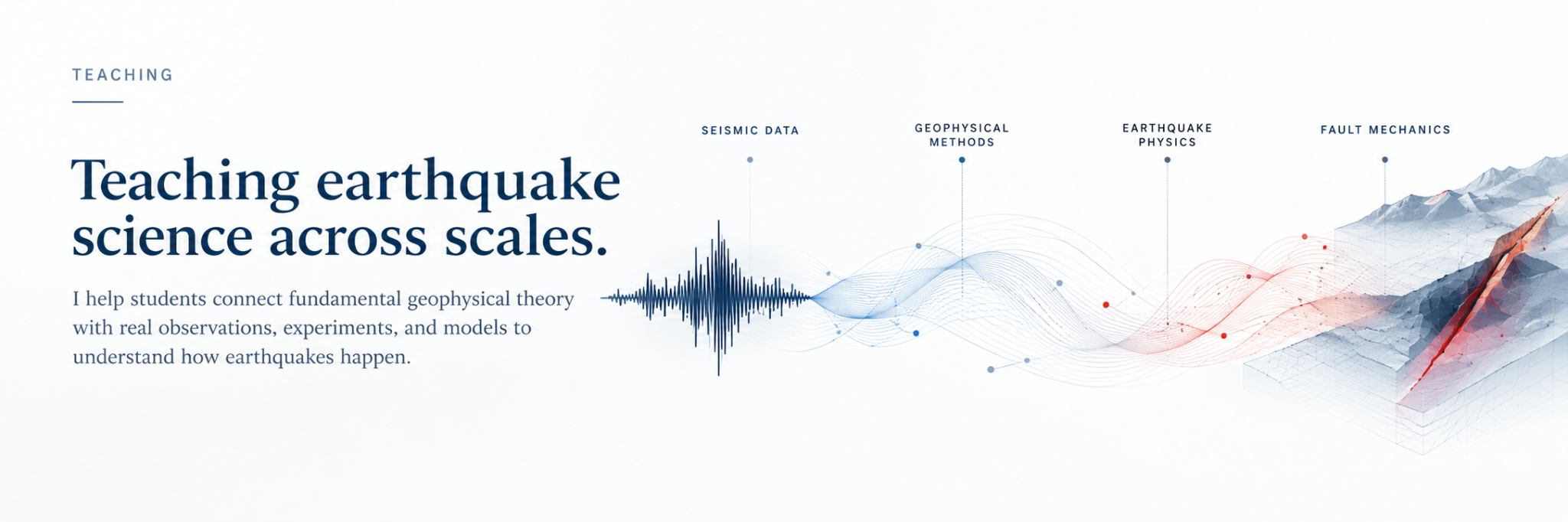
My approach to teaching connects fundamental geophysical theory with the observations, computational methods, and physical processes used to study active faults. I aim to help students move comfortably between seismic data, mathematical methods, earthquake-source physics, and fault mechanics while developing the quantitative skills needed for independent research.
Earthquake detection and location
Earthquake catalogs
Focal mechanisms
Seismic networks
Earthquake sequences
Signal processing
Inverse problems in geophysics
Seismic data analysis
Quantitative interpretation
Earthquake-source physics
Rupture processes
Fault segmentation
Earthquake-cycle physics
Rock mechanics
Fault friction
Laboratory deformation experiments
Connecting laboratory measurements to natural faults
I want students to understand why a method works before treating it as a computational tool. A focal mechanism, an inversion result, a friction experiment, or an earthquake-cycle simulation becomes more meaningful when the underlying physics can be connected to an observable feature of a real fault system.
Boğaziçi University
Supported students in developing the mathematical, computational, and physical foundations required for quantitative geophysics.
Mentoring in earthquake science with emphasis on scientific problem formulation, quantitative analysis, interpretation of results, and development of independent research skills.
Observational seismology · Seismic data analysis · Fault mechanics · Earthquake physics · Scientific interpretation
Connect mathematical concepts to observable earthquake and fault behavior.
Use real seismic observations, experiments, and numerical results to explore scientific questions.
Move beyond producing a numerical answer toward understanding its physical meaning.
My goal is to train students to move confidently between observations, theory, computation, and physical interpretation.